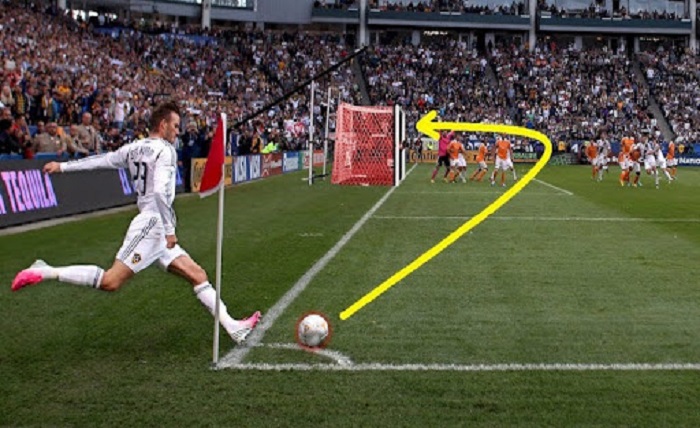
In a football match, dead-ball situations can create a turning point within just a few seconds. What is a corner kick is a familiar question for people who are new to watching football. It refers to a method of restarting play from the corner area of the pitch in situations specified by the Laws of the Game. Under Law 17 of IFAB, the attacking team is generally awarded a corner kick when the ball completely crosses the goal line, touches the last defending player, and no goal is scored.
People following XoilacTV or Xoilac365 also frequently encounter these situations in major matches.
1. What is a corner kick in football?
Simply put, what is a corner kick can be explained as a method of restarting a match from the corner area for the attacking team.
According to IFAB, a corner kick is awarded when the entire ball crosses the goal line, whether on the ground or in the air, after touching the last player of the defending team and without a goal being awarded.
For example, a striker shoots the ball, it hits a center-back’s leg, and then the ball goes completely over the goal line. In this case, the attacking team is awarded a corner kick.
Viewers of XoilacTV can recognize this situation when the referee points toward the corner flag. For those who regularly follow Xoilac365, this is one of the most common dead-ball situations.
2. Where is a corner kick taken?
After understanding what is a corner kick, it is important to know where the ball is placed.
Under Law 17, the ball is placed in the corner area nearest to where it crossed the goal line. The ball must be stationary and must be kicked by a player of the attacking team. The corner flagpost must not be removed.
The ball is in play when:
- It has been kicked.
- It clearly moves.
- It does not have to leave the corner area completely.
The corner kick is taken from the corner arc nearest to where the ball crossed the goal line.
When watching XoilacTV, viewers may sometimes see a player place only part of the ball over the corner arc. IFAB confirms that the ball does not necessarily have to be completely inside the corner arc as long as its position complies with the regulations.
3. How far away must opposing players stand?
An important rule when learning what is a corner kick concerns the distance opposing players must keep.
According to IFAB, opponents must remain at least 9.15 m away from the corner area until the ball is put into play.
This rule gives the player taking the corner enough space to pass or cross the ball.
Viewers of XoilacTV often see referees ask defenders to move back if they are standing too close to the player taking the kick. This is a small but important detail for correctly understanding how a corner kick is taken.
4. Can a player score directly from a corner kick?
The answer is yes. This is an interesting detail when explaining what is a corner kick.
IFAB stipulates that a player can score directly from a corner kick, but the goal is only awarded if the ball goes directly into the opponent’s goal.
This type of goal is commonly known as an Olympico. The player must deliver the ball with a sufficiently curved trajectory to beat the goalkeeper and go directly into the net.
If the ball from a corner kick goes directly into the team’s own goal without touching anyone, the opposing team is awarded a corner kick rather than it being counted as an own goal.
Such rare goals often create significant excitement among XoilacTV viewers.
5. Common ways to take a corner kick
Understanding what is a corner kick also requires knowing the tactical options used.
5.1. Crossing directly into the penalty area
This is the most common approach. The player delivers the ball into the area in front of the goal so that center-backs or forwards can compete for an aerial ball.
5.2. Short corner
Instead of crossing immediately, the player passes to a nearby teammate to create a two-versus-one situation and change the angle of attack.
5.3. Delivering the ball toward the near post
The attacking team can target the near post so that a player can flick the ball on with a header or set it up for a teammate behind them.
5.4. Delivering the ball toward the far post
This approach takes advantage of players with good physical stature or strong aerial ability positioned behind the defensive line.
Football teams can use various corner-kick routines, such as direct crosses, short combinations, near-post deliveries, or balls toward the far post.
XoilacTV viewers can observe how different teams position their players in very different ways even when awarded the same corner kick.
6. Is there an offside rule for corner kicks?
This is another common question after asking what is a corner kick.
Under the Laws of the Game, a player cannot be penalized for offside when receiving the ball directly from a corner kick. Therefore, the attacking team can position several players close to the goal without immediately being called offside from the corner kick itself.
However, once the ball is touched by a teammate and the play develops into a new situation, the offside rule can apply normally depending on what happens next.
XoilacTV viewers should pay attention to this point to avoid confusing a player’s position during the corner kick with their position during subsequent passes.
7. New rules related to corner kicks and goalkeepers
A notable change that broadens the topic of what is a corner kick came with the 2025/26 edition of the Laws.
IFAB stipulates that if a goalkeeper controls the ball with their hand or arm for more than 8 seconds, the opposing team is awarded a corner kick. The referee uses a hand countdown signal during the final seconds so that the goalkeeper knows how much time remains.
Under the current Law 17, a corner kick can also be awarded when the referee penalizes a team for delaying the taking of a goal kick in circumstances specified by the Laws.
This is an important point for XoilacTV viewers to note, because in the past, corner kicks were mainly associated with a defender being the last player to touch the ball before it went out over the goal line.
8. Why are corner kicks important tactically?
Once you understand what is a corner kick, it becomes clear that it is more than simply a way to restart play.
A corner kick gives the attacking team an opportunity to send several players into the penalty area and prepare specific attacking routines. Teams with tall center-backs, players who are good at crossing, or set-piece specialists often have a significant advantage.
Corner kicks also affect:
- The ability to create scoring chances.
- Pressure on the defense.
- The tempo during the final stages of a match.
- Counter-attacking opportunities if the attacking team loses possession.
A corner kick is an important set-piece situation that helps teams create scoring opportunities through pre-planned routines.
Fans of XoilacTV should not look only at the football standings when evaluating a team. The ability to capitalize on set pieces also reflects the tactical quality of the team as a whole.
9. Do corner kicks affect the outcome of a match?
Although it is only a dead-ball situation, a corner kick can directly lead to the decisive goal.
In the final minutes, a team that is behind may send even its center-backs into the penalty area to take advantage of their aerial ability. In decisive matches, the goalkeeper may even join the attack.
Therefore, in addition to following bảng xếp hạng bóng đá, XoilacTV fans can pay attention to corner-kick statistics to better understand how a team creates pressure on its opponents.
10. Conclusion
What is a corner kick? It is a method of restarting play from the corner area of the pitch, most commonly when the ball completely crosses the goal line after touching the last defending player and no goal has been scored. Under the current Laws, a player can also score directly from a corner kick, while opponents must maintain a minimum distance of 9.15 m.
For those following XoilacTV or Xoilac365, understanding the rules of corner kicks makes watching football easier, especially in dead-ball situations that can decide the result with just one accurate cross or header.