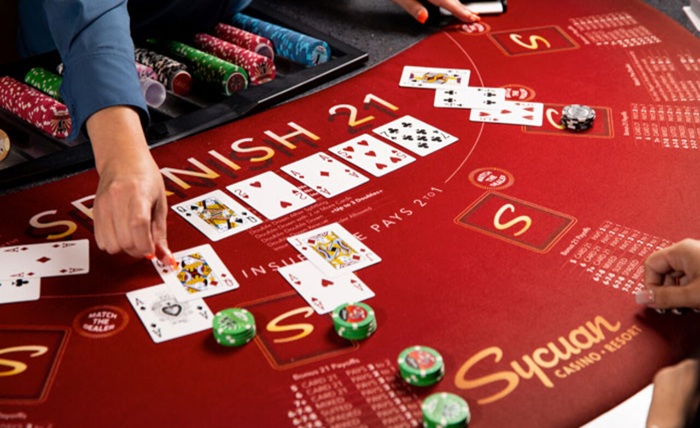
Blackjack is one of the most popular casino card games in the world. So, it’s unsurprising that several variants of the game have emerged over the years, each with its own unique rules and playing styles. One of the most interesting of these is Spanish 21, a variant that looks very similar to regular blackjack.
In this guide, we’ll explore the Spanish 21 game, covering its basic rules and walking you through how to play it step by step.
Spanish 21: Features and Rules of The Game
Unlike purely chance-based games like casino slots, blackjack involves more decision-making. And with Spanish 21, there’s even more strategy involved. This variant has the same basic objective as traditional blackjack, which is to build a hand that is closer to 21 than the dealer’s without going over. However, there are a few unique rules and features that make its gameplay different.
A Modified Spanish Deck is Used
The first major difference is the deck of cards used. Spanish 21 simply removes all four 10-card suits from the deck used in traditional blackjack. The Kings, Queens, and Jacks are still worth 10 points. But the cards specifically numbered 10 are not used in the game. This makes the total number of cards 48, instead of the 52 that a standard deck contains.
Card Values
Although the deck is different, the values assigned to the cards remain exactly the same as in traditional blackjack. That is, cards numbered 2 through 9 are worth their face value, while the Kings, Queens, and Jacks are each worth 10 points. The Ace is the most flexible card in the game. It can be counted as either 1 point or 11 points. This depends on which value benefits your hand the most.
Objective of the Game
As mentioned, the goal of Spanish 21 is the same as the goal of traditional blackjack: beat the dealer without going over 21. There are several ways this can happen.
- Beating the dealer without busting: After receiving your cards, if your total exceeds 21, you “bust” and automatically lose the hand, regardless of what the dealer has.
- Reaching 21: This can happen with your first two cards or after drawing additional cards during the hand. In many versions of Spanish 21, certain combinations that total 21 can even qualify for bonus payouts.
- Winning with a higher hand value: If neither you nor the dealer busts, that is, exceeds 21, the winner is the person whose hand is closer to 21. However, with the same total, the result is usually a push, meaning your original wager is returned and neither side wins the hand.
How to Play Spanish 21 Step-by-Step
Spanish 21 also follows the round-by-round structure used in traditional blackjack. That is, placing your bet, receiving your cards, making your decision, and then comparing your hand with the dealer’s. Here is how a round usually goes:
Step 1: Place Your Bet
Every round begins with a wager. Before any cards are dealt, you must place your bet. There are usually minimum and maximum bet limits, and online versions usually display these limits.
Step 2: Receive Your Cards
After everyone has placed their bets, the dealer gives each player two cards. The dealer also receives two cards. In most versions of the game, one of the dealer’s cards is placed face up. This is called the dealer’s upcard. The other card is placed face down and is known as the hole card.
Your job is to look at your own hand, compare it with the dealer’s visible card, and decide the best move to make.
Step 3: Choose Your Action
Spanish 21 gives you several options to make, including:
- Hit: To hit means to take another card. You usually hit when your hand total is low, and you need to improve it. For example, if you have a total of 11, taking another card is often a strong option.
- Stand: To stand means to keep your current hand and take no more cards. For example, if you have a total of 19 or 20, standing is usually the safer move because your hand is already strong.
- Double Down: Doubling down allows you to increase your original bet to receive one additional card in return. Doubling down lets you put more money on the table when you believe you have a strong chance of winning.
- Split: Splitting is available when your first two cards are of the same value. For example, if you are dealt two 8s, you can split them, such that each 8 now becomes the first card of a new hand. But you must place an additional bet equal to your original wager.
- Surrender: Surrender allows you to give up your hand and recover part of your bet, usually half. This option is useful when your chances of winning the hand are very low.
Step 4: Dealer Plays Their Hand
After all players have made their decisions, the dealer reveals the hole card and plays their hand according to the table rules. Dealers don’t make strategic choices; they must follow fixed rules. In most games, the dealer must keep drawing cards until their hand reaches at least 17.
Step 5: Determine the Winner
Once the dealer finishes playing, the hands are compared, and the winner is decided. You can win if your hand is closer to 21 than the dealer’s hand without going over, if the dealer busts and you haven’t, and if you hit exactly 21.
Spanish 21: Special Rules
Since the number 10 cards are removed, Spanish 21 seems less favorable to players. To compensate for this, it brought in several special rules that are not usually found in traditional blackjack. Below are some of the most important ones.
- Player blackjack always wins: In traditional blackjack, if both you and the dealer are dealt blackjack, the result is typically a push. However, in most versions of Spanish 21, a player’s blackjack automatically beats a dealer’s blackjack.
- Late surrender: Spanish 21 often includes a feature known as late surrender. That is, you’re allowed to forfeit your hand after the dealer checks for blackjack. That way, you only lose half of your wager.
- Double down rescue: In some versions of the game, if you double down and receive an unfavorable card, you may be allowed to “rescue” your doubled wager. This means you can surrender the hand and recover part of the additional wager.
- Redoubling opportunities: Unlike standard blackjack, many versions of Spanish 21 also allow you to redouble, that is, double down multiple times on the same hand.
- Bonus payouts: Sometimes, if your total is exactly 21, you can qualify for additional rewards beyond the standard even-money payout. If you get exactly 21 with five cards, you get an even bigger bonus. The same applies when it’s done with six, seven, or eight cards, and especially three 7 cards.
Conclusion
Spanish 21 follows the same basic goal as blackjack, but a few key rule changes make it a different game. Removing the 10 cards from the deck changes the odds while the extra player-friendly features create new opportunities and strategic decisions. Once you’ve seen the rules in action when you play, you’ll have a much better understanding of what makes Spanish 21 stand out from traditional blackjack.