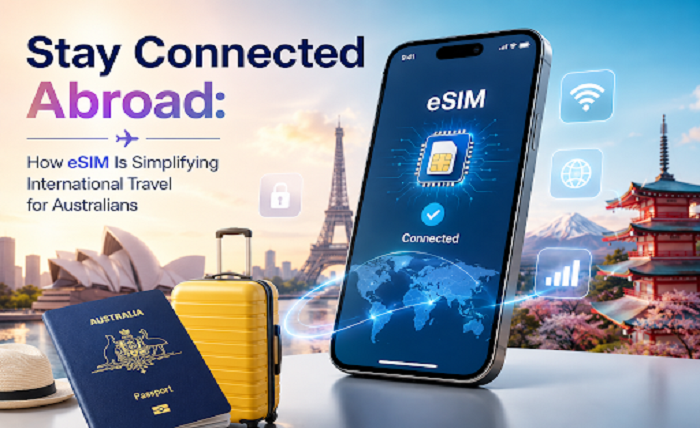
Landing in another country used to create an immediate problem. That is you needed mobile data.
That often meant finding a local SIM card, waiting at an airport kiosk, changing the SIM in your phone and keeping track of the tiny card you had just removed. eSIM technology has made this process much simpler.
An eSIM is a digital SIM built into a compatible smartphone. Instead of inserting a physical card, you can download and activate a mobile plan digitally. For Australians travelling overseas, this can mean having a travel data plan ready before the plane lands.
It can also let you keep your Australian number while using a separate plan for mobile data overseas.
What Makes eSIM Different From a Regular SIM?
A traditional SIM is a removable piece of hardware.However, an eSIM performs the same basic function but is built directly into the device.
That means there is nothing to remove, store or physically replace when you change mobile plans.
Apple says compatible iPhones can store eight or more eSIMs and use two eSIMs at the same time on supported models. This is particularly useful for frequent travellers.
You could have your Australian mobile plan stored on the phone and add separate travel plans for countries you visit regularly.
Instead of carrying several physical SIM cards, you manage your plans through your phone’s settings.
Why Australians Are Turning to eSIM for Overseas Travel
The biggest benefit is convenience. You can purchase a suitable travel plan before leaving Australia. Depending on the provider, activation may involve a QR code, an app or another digital activation method. That means you do not necessarily need to search for a mobile shop after arriving.
This can be particularly useful at airports. Imagine landing in Japan after a long flight. You need directions to your hotel, a translation app and a rideshare service.
With a correctly installed travel eSIM, you can potentially connect to mobile data as soon as you arrive.
You do not need to find a physical SIM seller first.
You Can Keep Your Australian Number
This is where eSIM becomes especially useful. Many compatible phones support dual SIM functionality.
You can keep your Australian number as your primary line and use a travel eSIM as a second line.
Apple specifically describes international travel as a use case for Dual SIM, allowing one number to remain your home line while another provides service at your destination.
This means you can continue receiving important messages on your Australian number while using the travel eSIM for data.
However, there is an important catch. Keeping your Australian line active does not automatically prevent roaming charges. Your Australian provider may charge for calls, texts or data depending on your plan.
Before travelling, check your carrier’s international roaming conditions.
Is an eSIM Cheaper Than Roaming?
Not necessarily. This is one of the most important points travellers should understand. An eSIM is simply a way of connecting to a mobile network. It does not guarantee a cheaper service.
You may find a travel eSIM with a fixed data allowance at an attractive price.
Your Australian carrier may offer an international roaming package that includes data, calls and messages.
The better option depends on your trip.
Compare:
- Total cost
- Data allowance
- Validity period
- Countries covered
- Network coverage
- Internet speed
- Calls and SMS
- Hotspot support
- Activation requirements
A data-only eSIM can be excellent for maps, messaging and browsing.
It may be less suitable if you need a local telephone number for calls or bookings.
What About the iPhone 15?
The iPhone 15 is well suited to international travel. Apple’s Australian specifications list both Dual eSIM support and Dual SIM using a nano-SIM and eSIM for the iPhone 15.
That gives Australian owners flexibility.
You can use your Australian SIM or eSIM and add a compatible travel eSIM when visiting another country.
If you purchase a travel eSIM from a different provider, the iPhone needs to be unlocked for use with another carrier.
Apple says you can check this by opening Settings, selecting General and About, then looking for No SIM Restrictions under the carrier lock information.
This is worth checking before buying a travel plan.
What About Other iPhone Models?
eSIM is not limited to the iPhone 15. Apple supports eSIM on iPhone XS, iPhone XS Max, iPhone XR and later models, provided the relevant carrier supports eSIM.
Newer iPhone models can also support two active eSIMs. However, travellers should pay attention to where a phone was purchased.
SIM configurations can differ between countries and regions. For example, Apple’s current documentation lists different eSIM and physical SIM configurations for certain regional iPhone models.
This is especially important if you buy an iPhone overseas and intend to use it in Australia.
Android Phones Can Use eSIM Too
eSIM is not an Apple-only technology. Many modern Android phones support it. Samsung, for example, lists eSIM support across numerous Australian Galaxy models, including recent Galaxy S and Galaxy Z devices.
However, Android compatibility is more complicated because there are many manufacturers and models.
Two Android phones from the same brand may not necessarily support identical SIM configurations. Samsung also warns that eSIM availability depends on the model, region and carrier.
Therefore, always check the exact model rather than assuming that every Android phone supports eSIM.
How to Prepare Your eSIM Before Flying
Do not wait until you are standing at the airport to figure everything out.
Prepare before leaving Australia.
1. Check your phone
Confirm that your iPhone or Android phone supports eSIM.
If you purchased the device overseas, check the regional model specifications carefully.
2. Check that the phone is unlocked
A carrier-locked phone may prevent you from using another provider’s travel eSIM.
On an iPhone, Apple provides the No SIM Restrictions check in Settings.
3. Choose your destination plan
Make sure the plan covers every country you will visit.
A plan covering Japan does not necessarily cover South Korea, Singapore or Australia.
If your holiday includes several countries, consider a regional plan.
4. Install the eSIM
Follow the provider’s instructions.
You may receive a QR code or activation through an app.
Apple supports several eSIM activation methods, including QR codes, carrier activation and provider apps.
5. Decide which line handles data
When you arrive, select the travel eSIM for mobile data if that is what your plan requires.
Keep your Australian line configured according to your carrier’s roaming instructions.
6. Test everything
Check that mobile data works before relying on it.
It is much easier to fix an activation problem while connected to reliable Wi-Fi in Australia than after landing overseas. Click here.
Is an eSIM Worth Using on Your Next Trip?
For many Australian travellers, it is. The biggest advantage is not simply replacing a plastic SIM.
It is the flexibility. You can prepare your connection before travelling, keep your Australian number and use another plan for overseas data.
But do not choose an eSIM based on price alone. Check the network coverage, data allowance, validity period and roaming conditions.
However, for occasional travellers, your existing Australian carrier’s roaming package may be the easiest solution.