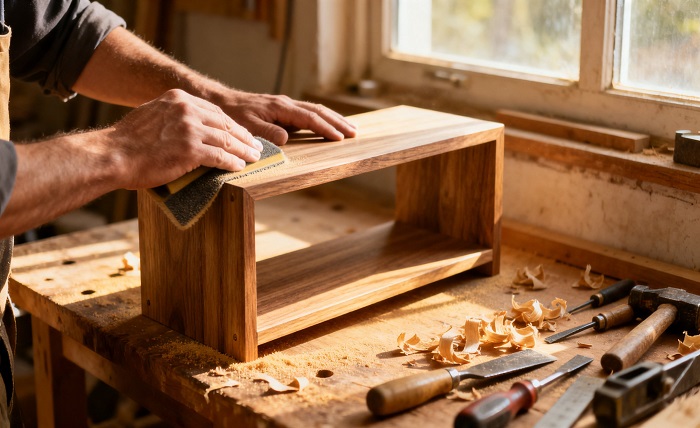
A good DIY video lives or dies on clarity, hands moving through each step, materials transforming in real time, the process actually visible rather than implied. A photo can show a finished project, but it can’t show how it got there. Text to video tools finally make that process visible, and Dreamina’s Seedance 2.5 renders hands-on demonstrations with enough physical accuracy that a viewer can actually follow along.
Why DIY content depends on visible process
A finished project photo answers “what,” but a DIY audience wants “how.” Motion is what actually teaches, the angle of a hand holding a tool, the pressure applied while sanding, the order steps happen in. Without that visible process, a DIY video is just a before-and-after with nothing useful in between.
Picking the step that matters most
Trying to show an entire project start to finish in one clip usually loses the useful detail. Focus on a single instructive step instead:
-
The most technically tricky part of the process
-
A satisfying transformation moment, paint drying, a piece coming together
-
A close, careful shot of a specific technique
One clear step teaches more than a rushed overview of the whole project.
Writing a prompt that shows the technique clearly
A vague prompt like “DIY project” skips the part that actually matters, the technique itself. Describe the specific hand position, tool, and material interaction, sanding along the grain, painting in even strokes, and keep the camera angle close enough to actually see it. That clarity is what makes a demonstration useful instead of just decorative.
Your three-step path from idea to finished scene
Step 1: Set up your workbench
Visit Dreamina, sign in, and head to the “AI Video” section. Click “Add reference image” if you have a photo close to the project you’re picturing, then write your prompt describing the technique. For text-to-video creations, skip the image and describe the full process instead.
Here’s an idea: A pair of hands sanding a wooden shelf on a workbench, smooth even strokes moving along the grain, fine sawdust drifting in warm window light, a can of stain and a brush waiting nearby, the camera holding steady close on the hands before slowly pulling back to reveal the full workbench.
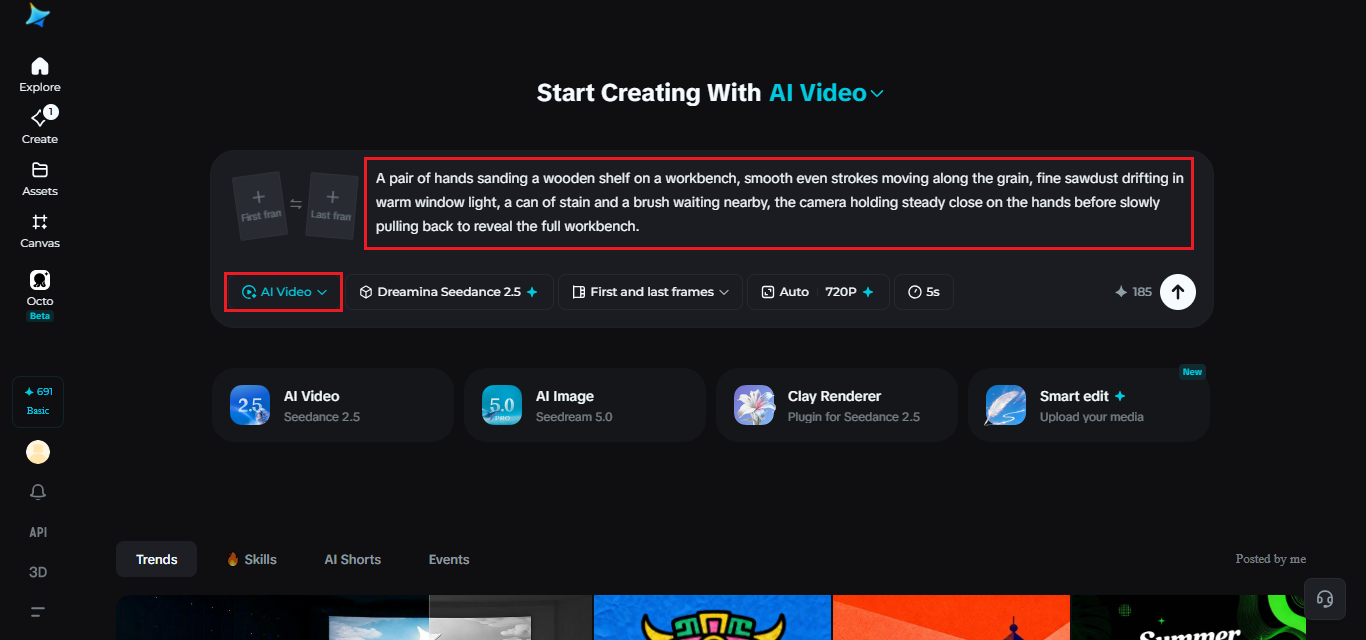
Step 2: Let Seedance 2.5 handle the technique
Choose the Seedance 2.5 model once your prompt is ready, since it handles precise hand movement and material detail well. Pick a video length, then an aspect ratio, 16:9 for YouTube or 9:16 for TikTok. Click Dreamina’s generate icon and wait a few seconds for the render.
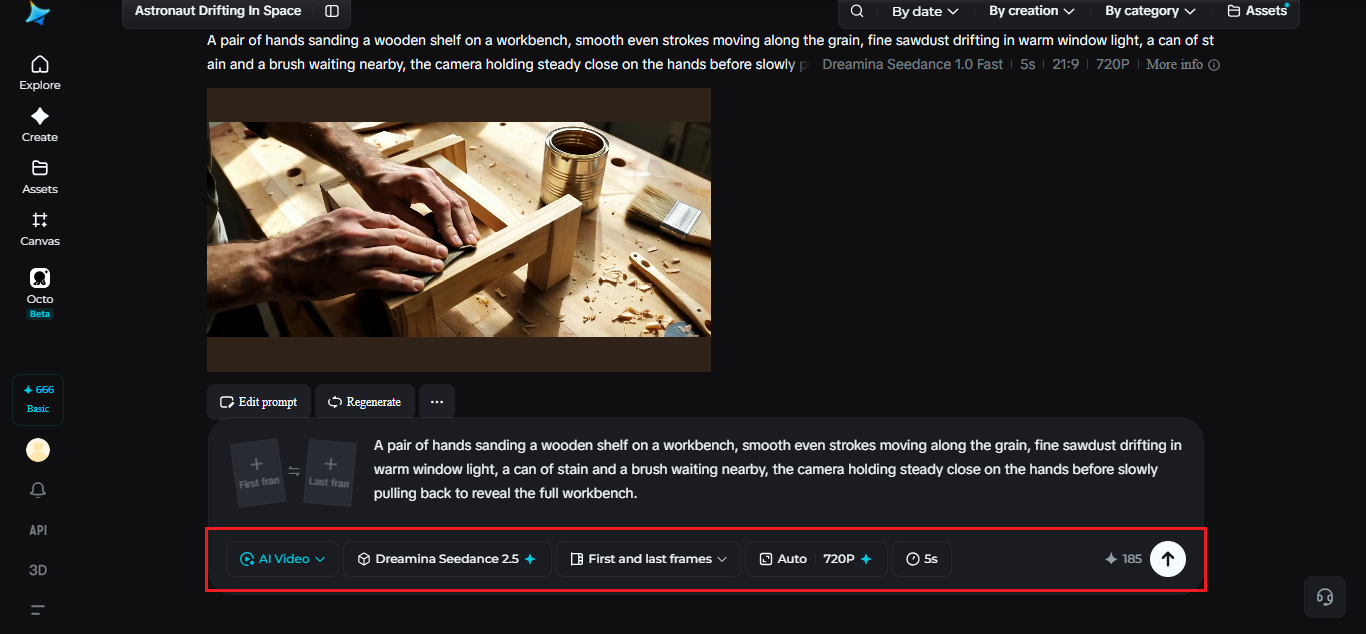
Step 3: Clean up the demo and export
Check the clip once it returns, making sure the hand movement and material reaction look physically accurate. Use Upscale to sharpen fine detail like wood grain and tool edges, and Generate soundtrack to add ambient workshop sound. Export once it’s ready to share.
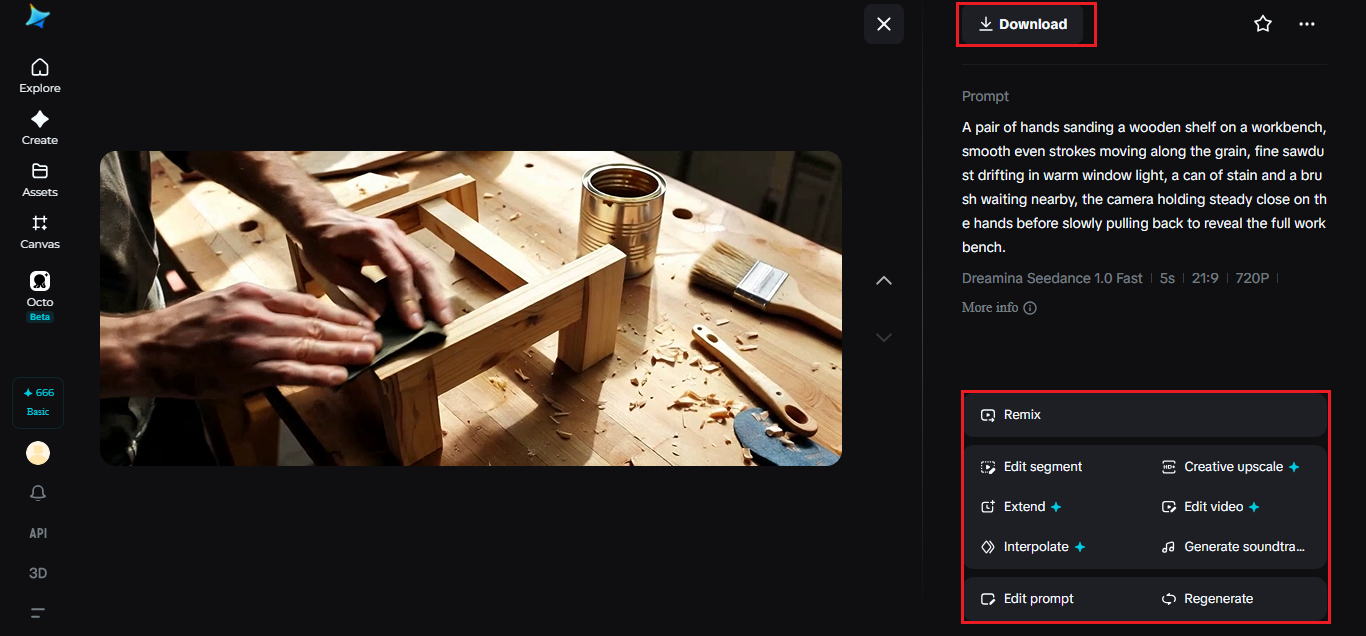
How Seedance 2.5 handles precise, hands-on motion
Seedance 2.5 was engineered to render the kind of fine, repeated motion that DIY demonstrations depend on for actually being useful.
Authentic hand and tool motion
Repeated actions, sanding, brushing, cutting, stay physically consistent across a sequence instead of drifting or glitching between frames, which matters when a viewer is trying to actually learn the motion.
Material response that reads as real
Wood, paint, and fabric respond to tools the way they actually would, sawdust falling correctly, paint spreading evenly, rather than behaving like a flat texture with no physical interaction.
Extended duration for full demonstrations
Ultra-long generation up to 180 seconds lets you show a full technique or short process start to finish without cutting away mid-step.
A second angle that reinforces the technique
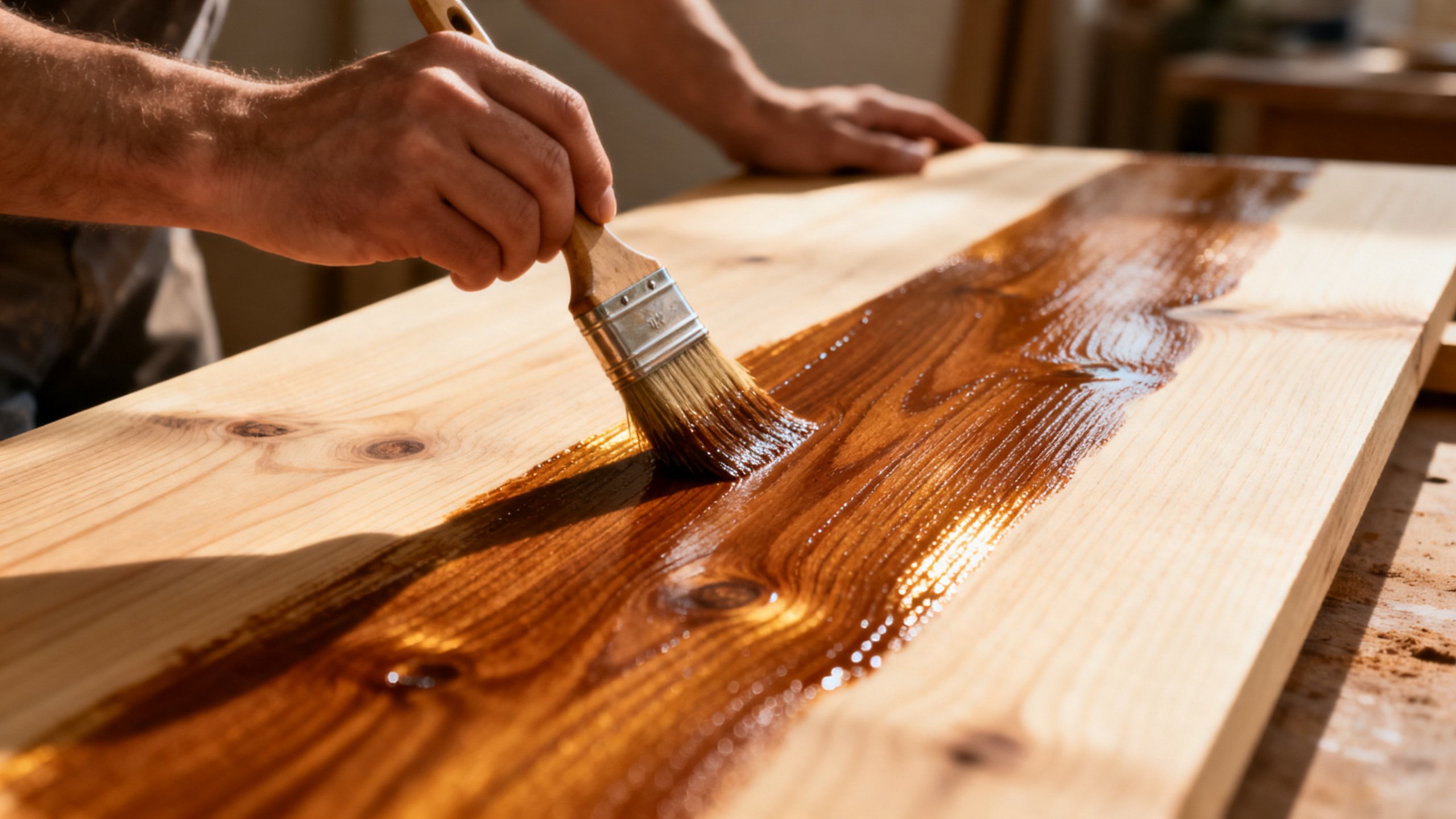
Not every DIY shot needs to show the whole workbench. A tighter, closer angle, just the hands and the material, reinforces the technique without distraction. Mixing in a shot like this makes a demonstration easier to actually follow.
Sound that completes the workshop feel
DIY content benefits from grounded, practical sound, the scrape of sandpaper, a brush moving across wood, quiet ambient workshop noise. Dreamina’s soundtrack tool can add that texture directly without needing a separate recording setup.
Keeping the pace realistic
DIY techniques take time, and rushing the motion in a prompt can make a process look unconvincing even when the material response is accurate. Describing a steady, unhurried pace, sanding at a natural rhythm, a brush moving without rushing toward the edge, keeps the demonstration feeling like something a person could actually replicate. Viewers trying to learn from a clip notice when the pacing feels off, even if they can’t say exactly why. Matching the speed of a real technique, rather than compressing it for effect, is often what makes a demonstration genuinely useful.
Where these demonstrations are already being used
Craft and hobby creators use them to preview a technique before filming the real thing, small businesses use them to demonstrate products without a full studio setup, and educators use them to make hands-on skills easier to visualize for beginners. A technique that once needed a camera crew and good lighting can now start as a written description.
Teaching a DIY technique used to mean filming take after take until the angle and lighting worked. With Dreamina and the precise, material-aware rendering of Seedance 2.5, that process can be built from a written idea, letting anyone show a technique clearly before ever picking up a tool on camera.