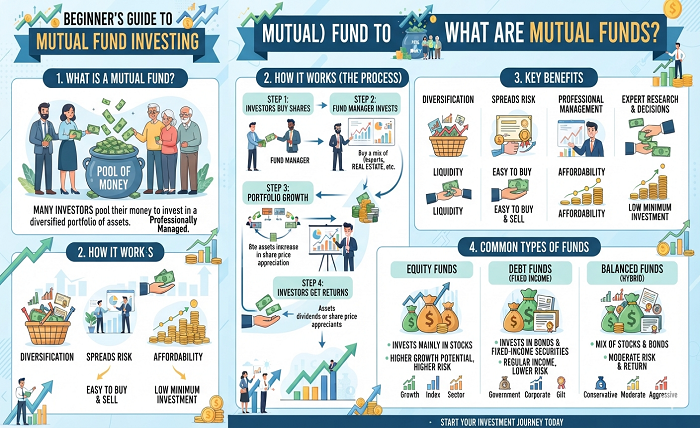
Mutual funds offer a way to participate in financial markets without selecting and monitoring every security independently. They bring together money from many investors and place it in a portfolio built around a stated objective. A professional fund manager oversees that portfolio, while each investor owns units representing a proportionate interest in the scheme.
For a beginner, the useful starting point is not recent performance. It is understanding what a scheme holds, why it holds those assets, how much risk is involved and whether the investment horizon matches the goal.
H2: How mutual funds are structured
An asset management company launches and manages schemes under an established regulatory framework. Money collected by a scheme is invested according to the asset allocation and strategy described in its offer documents. The portfolio may contain shares, bonds, money market instruments or a combination of assets.
The net asset value, commonly called NAV, is the per-unit value of the scheme after accounting for its assets and liabilities. Purchases and redemptions are generally processed using the applicable NAV under the scheme rules. A lower NAV does not make one scheme cheaper or more suitable than another; portfolio quality, mandate, costs and risk are more meaningful considerations.
H2: Common types of mutual funds
The broad categories differ mainly in what they invest in and how their values may fluctuate. Here are the different types of mutual funds:
H3: Equity funds
Equity funds invest predominantly in shares of companies. They may be classified by company size based on market capitalization, investment style, sector or another defined mandate. Equity prices can move sharply, so these funds are generally considered for goals with a longer horizon and for investors able to accept market volatility.
H3: Debt funds
Debt funds invest in instruments such as government securities, corporate bonds and money market securities. Their risks include changes in interest rates, credit quality and liquidity. They are not fixed-return products, and different debt categories can behave quite differently.
H3: Hybrid funds
Hybrid schemes combine equity and debt, sometimes with other permitted assets. The balance varies by category and scheme. This mix may help investors obtain exposure to more than one asset class, but it does not remove market risk.
H3: Index funds
Index funds seek to track a chosen market index before costs and tracking differences. They follow a rules-based portfolio rather than relying on active security selection. The risk depends on the underlying index and the assets it represents.
H2: Ways to invest
Investors may contribute a one-time amount or use a Systematic Investment Plan, commonly known as an SIP. An SIP invests a chosen amount at regular intervals. This can support consistency and spreads purchases across different market levels, though it does not assure gains or prevent losses.
A one-time investment puts the full amount to work at once. It may suit an available surplus when the chosen scheme, risk profile and investment horizon are aligned. The two routes are funding methods, not separate products, and neither is universally suitable.
H2: Costs, risk and access to money
Schemes charge expenses for management and operations, reflected in the NAV. Some may also apply an exit load when units are redeemed within a specified period. Investors should check the expense ratio, exit-load terms and tax implications before proceeding.
Liquidity depends on the scheme. Many open-ended mutual funds permit redemption on business days, but the payment timeline and any restrictions vary. Market movements can also mean the redemption value is lower than the amount invested.
H2: What beginners should check before investing
Start with the goal, the date on which the money may be needed and the amount of fluctuation you can tolerate. Then read the scheme’s investment objective, asset allocation, risk factors, benchmark and portfolio information. The riskometer can provide a standardised indication of the scheme’s stated risk level.
Diversification deserves attention too. Holding several schemes that own similar securities may create duplication rather than meaningful diversification. A smaller, clearly understood portfolio can be easier to review than a collection assembled from recent recommendations.
H2: A measured first step
Mutual fund investing becomes easier to assess once the scheme category, underlying assets and time horizon are clear. Begin with an amount that fits the household budget, retain money for near-term needs and review the investment periodically without reacting to every market movement. Where the choice is unclear, a qualified investment adviser can help assess suitability in light of personal circumstances.
H2: Keep expectations grounded
The first few months may say little about whether a long-term investment is fulfilling its role. Values can move in either direction, and different categories will react differently to market events. A review should return to the original goal and the scheme mandate rather than treating every fluctuation as a signal to act.
Mutual Fund investments are subject to market risks, read all scheme related documents carefully.